Using Bulk Tool Configuration, you can select the course components that you want to copy. These settings are used when you run the Copy Course Bulk process. Bulk Tool Configuration appears in the Admin Tools menu after you enable Copy Course Bulk and have the Manage Settings permission for at least one bulk tool.
Understand how copy behavior works
Copy Course Bulk handles copied components differently depending on the component type:
- Course activities: Content, Assignments, Quizzes, Discussions, and grade items are appended to the destination course. Existing activities in the destination course remain unchanged, and copied activities are added as new items.
- Course-level settings: Grading or other configuration settings are copied to the destination course as a single set of course settings. Because a course can only have one set of these settings, the copied settings can replace the existing settings in the destination course.
- Files in Manage Files: are copied to the destination course.

|
Important: If a file with the same name already exists in the destination course, the existing file is overwritten.
|
Bulk copy course components
You can use Course Copy Bulk to copy course components.
To copy course components
- From the Admin Tools menu, click Bulk Tool Configuration > Course Copy Bulk.
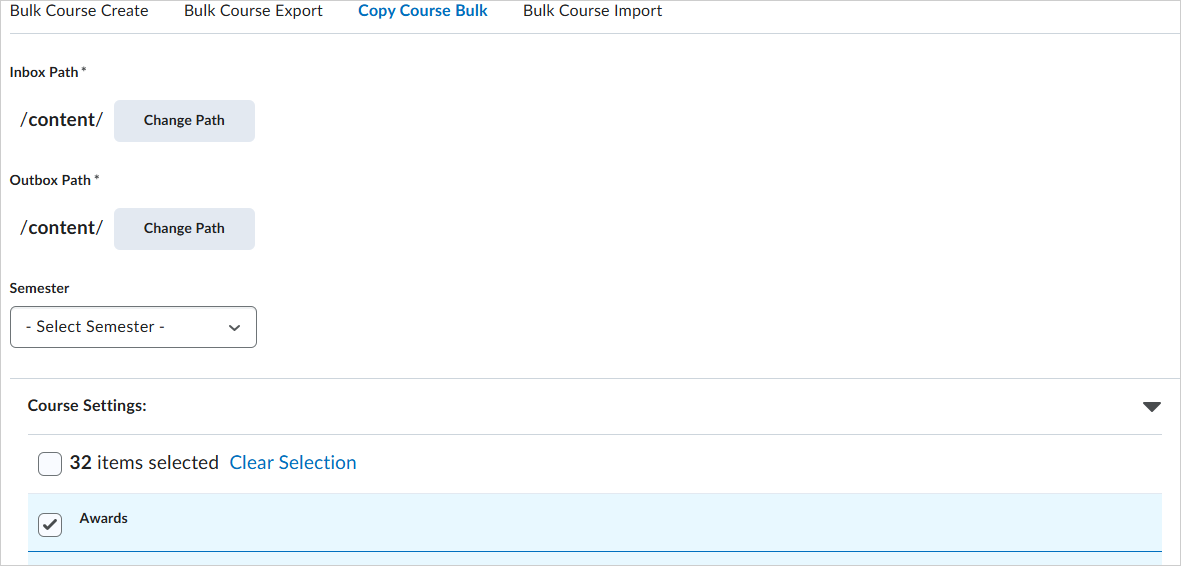
- Do one or more of the following:
- Verify that the Inbox Path shows the location where you want to place the input CSV file.
- Verify that the Outbox Path shows the location where you want the CSV file to move to when processing is complete.
- If no paths exist, click Change Path to browse to the appropriate directory paths.
- To specify the Semester in which to create the courses, select a semester from the list. This value is used if the CSV file contains no semester value or an invalid value.
- To select the course settings that you want to copy to the new course, choose the applicable settings or select all settings.
- Click Save.
Specify course offerings to copy in your CSV file
You can specify the course offerings to copy in one or more CSV files located in the inbox folder. Unless you configure the tool to leave the CSV file in the inbox folder, Copy Course Bulk moves the file to the outbox folder after processing. Each line in the CSV file after the header row represents one course offering to copy.
You can specify the following values for each course:
|
Field
|
Description
|
|---|
|
Source Course Code or Org Unit ID
|
The course code or Org Unit ID number for the course offering. This value appears on the Org Unit Editor page, where the ID appears in parentheses beside the course offering name. It also appears in the browser address bar when you access a course offering. This field is required.
|
|
New Course Name
|
The name for the new course or an existing course.
|
|
New Course Code
|
The course code for the new or existing course.
Note: This value can match an existing course. If you select the Make copy if course code exists option in Bulk Tool Configuration and this value matches an existing course, Copy Course Bulk makes a copy of the course.
|
|
Course Template Code
|
The code of the template to use for the new course. This template must already exist.
|
|
Semester Code
|
The OrgUnitCode of the semester in which to create the course. If this value is omitted, the semester from Bulk Tool Configuration is used.
|
|
Day Offset
|
The number of days to offset the dates on all activities copied into the new course. Enter a positive integer to move dates forward and a negative integer to move dates backward. To offset activity dates without entering a Semester Code, specify an empty string in the Semester Code column.
Note: This column is optional. If you do not enter a value, activities in the new course keep the dates copied from the source course.
|
|
Hour Offset
|
The number of hours to offset the source course time settings. Enter a positive decimal to move the time of day forward and a negative decimal to move it backward. To offset the time of day on activities without entering a Semester Code or Day Offset, specify an empty string in the Semester Code column and an empty string in the Day Offset column.
Note: If you do not enter a value, activities in the new course keep the time of day copied from the source course.
|
This sample CSV file copies four courses.
Source Course Code or OrgUnit ID,New Course Name,New Course Code,Course Template Code,Semester Code,Day Offset,Hour Offset
			6616,CCB Course 030,CCB_030,IMPORT TEMPLATE,FA2009,120,2
			1603,Calculus III (Winter 2008),Math309_W08,IMPORT TEMPLATE,
			2256,Calculus I (Winter 2008),Math117_W08,IMPORT TEMPLATE,
		1827,Linear Algebra III (Winter 2008),Math308_W08,IMPORT TEMPLATE,