Use Intelligent Agents to automatically identify users and take action based on activity in your course. This helps you re-engage learners, monitor performance, and automate administrative workflows.
Manage agents with a clear purpose
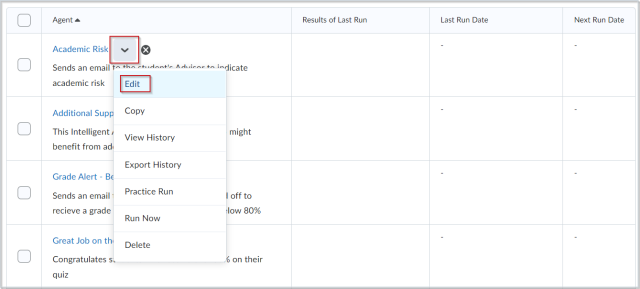
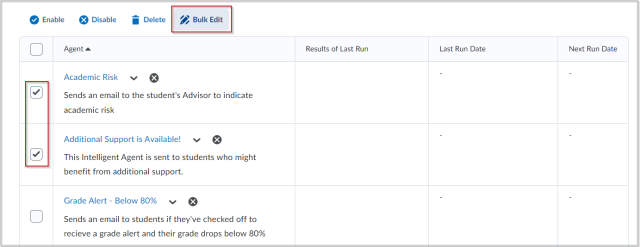
Use this page to review, update, enable, disable, or monitor existing Intelligent Agents. If you are creating an agent for the first time, refer to Set up Intelligent Agents.
What can you do with Intelligent Agents?
- Re-engage inactive learners
- Notify users based on grades
- Track course engagement
- Automate enrollments or role changes
How Intelligent Agents work
Agents evaluate users only when they run. They do not continuously monitor user activity. When an agent runs, it checks users against the criteria at that moment. If users meet the criteria, the agent performs the selected actions.

|
Important: If you select Take action only the first time the agent’s criteria are satisfied for a user, the system records that the user has already been processed. The agent does not act on that user again, even if the user’s state changes later. |
Typical workflow
- Define your goal.
- Build the agent.
- Test with a Practice Run.
- Run the agent or schedule it.
- Monitor results using View History.
Manage agents
Use the context menu and bulk actions to maintain existing agents.

Common agent patterns
One-time intervention
Use Take action only the first time the agent’s criteria are satisfied for a user when you want the agent to act once.
Example: Send a welcome email one time.
Ongoing monitoring
Use Take action every time the agent is evaluated and the agent’s criteria are satisfied for a user when you want repeated intervention.
Example: Send inactivity reminders.
Scheduled evaluation
Use a daily or weekly schedule when you want the agent to check for changes on a regular basis.
Example: Run a weekly engagement check.
Related articles
- To build a new agent, refer to Set up Intelligent Agents.
- To test and troubleshoot agent behavior, refer to Run Intelligent Agents.
- To understand concepts and examples, refer to About Intelligent Agents.