
When you hear Design Thinking, you might picture product developers or tech start-ups. However, the truth is that Design Thinking is just as powerful in Instructional Design (ID). At its core, it’s a human-centered problem-solving approach, and since IDs spend much of their time solving learning challenges, design thinking is a natural fit.
Why It Matters for IDs
Design Thinking helps us shift from “What content should I deliver?” to “What experience will actually help learners succeed?” By embracing empathy, iteration, and testing, IDs can craft solutions that are not only instructionally sound but also engaging and relevant.
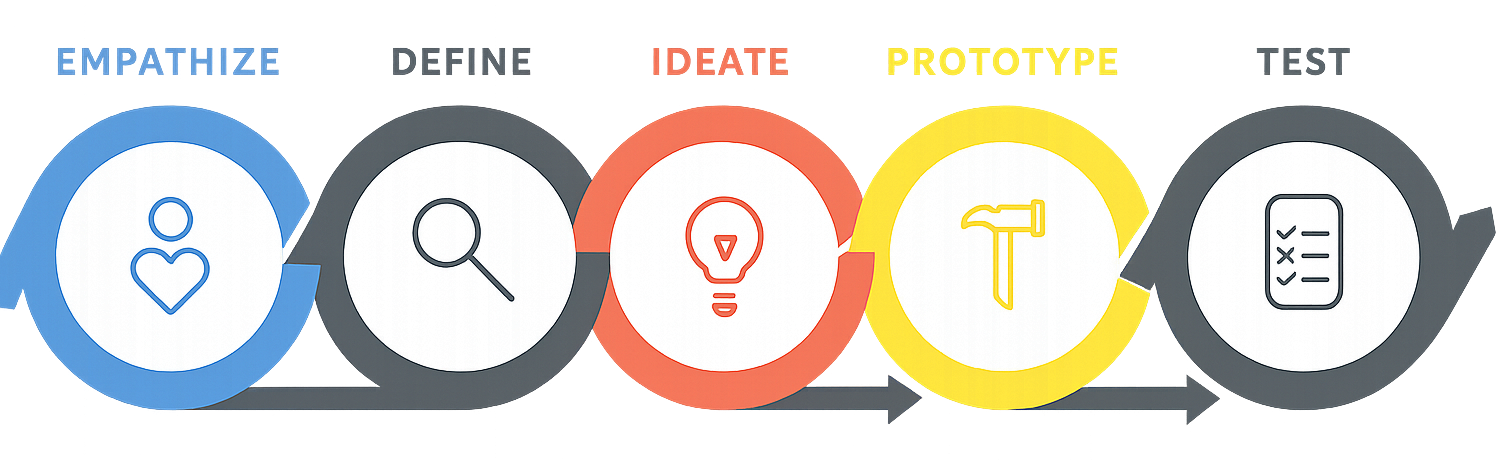
The Stages of Design Thinking (And How They Map to ID Work)
Empathize

Design Thinking starts with empathy, which involves understanding the learner’s needs, motivations, and pain points. In ID, this resembles learner analysis, which involves conducting surveys, interviews, or reviewing feedback to uncover what’s blocking success.
ID Tools/Practices:
Define

Next, you frame the problem. Before rushing into building, clarify: What’s the core challenge learners face? For example, “Learners struggle to apply safety protocols because the training is too theoretical.” Defining the problem keeps your solution anchored in reality.
ID Tools/Practices:
Ideate

Here’s where creativity comes in. Brainstorm a range of learning solutions without judgment — microlearning modules, scenario-based practice, coaching guides. The goal is to stretch beyond the obvious and generate multiple ways forward.
ID Tools/Practices:
Prototype

Rather than perfecting an entire course, build a small, testable version such as a sample scenario, a draft video, or a clickable outline. Prototyping lets you quickly see what resonates and what falls flat.
ID Tools/Practices:
Test

Finally, share your prototype with real learners or stakeholders. Their feedback becomes fuel for iteration. In ID, this is similar to pilot testing or beta reviews — a safe space to refine before rollout.
ID Tools/Practices:
Summary
As IDs, we’re already problem-solvers. Design Thinking offers a structured, human-centered approach to addressing these problems. Next time you kick off a project, try walking through the five stages — even briefly — and notice how it sharpens your design decisions.
Let’s keep the conversation going: Have you used Design Thinking in your ID work? What worked well, and what challenges did you face? Share your thoughts in the comments!
Want to Learn More?
Connect with your institute's D2L Customer Success Manager or Client Sales Executive, or reach out to the D2L Sales Team for more information about how Learning Services can support you on your learning journey.